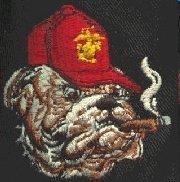
The announcement Friday that Gen. Peter Pace would not be returned to the post of chairman of the Joint Chiefs of Staff, initially made my heart sink. Other Marines felt — and feel — the same. I know, because I’ve received their e-mail messages.
To us it’s not so much because of who Pace is as a man and a four-star Marine general, though that certainly has something to do with it. But it’s what he represents to the history of our Corps as the first-ever Marine to lead the JCS.
We Marines are fiercely proud of that history, and for good reason.
Every single one of us who has ever worn the eagle, globe, and anchor is a part of that history. We’re taught that from day-one at boot camp or officer candidate school, and it’s something that creates a lifelong bond between Marines as well as a special appreciation for the accomplishments of our fellow Marines.
For instance, all Marines know that the first American to orbit the earth was Marine Col. John Glenn. The current director of the FBI, Robert Mueller, is a former Marine; as is New York City Police Commissioner Raymond Kelly. When Hollywood needed an actor who could play one of the Army’s toughest, most celebrated battlefield commanders, Gen. George S. Patton Jr.; they picked former Marine George C. Scott for the title role. And if I were to continue, this would not even be a warm up.
So when Pace became chief of the chiefs (In fact, he was the first Marine to become vice chairman.), we Marines were all thinking, “It’s about time†and “What finer man could there be to represent us?â€
“PERFECT PETE†Dubbed “Perfect Pete†by fellow officers, Pace graduated from the Naval Academy in 1967, rising through the ranks from a Marine rifle platoon commander in Vietnam to the highest-ranking American military officer in the world in 2005.
Pace’s not being renominated has nothing to do with his performance as chairman of the JCS. It has everything to do with what he symbolizes (American leadership while fighting a difficult war in Iraq) to the usual salivating suspects on Capitol Hill. And it was clear to Defense Secretary Robert Gates, and surely to President Bush, that Pace’s reconfirmation hearings would have been turned into a congressional circus: With poll-driven politicians focusing less on Pace’s performance and plans for the present and future prosecution of the war, and more on what has gone wrong in Iraq for the purposes of “show†and heaping blame, regardless of whether or not it is deserved, on any symbol of the Bush White House.
Pace is such a symbol. So he’s out. In his place, Gates has tapped Admiral Mike Mullen, also a Naval Academy grad (Class of ’68) and a Navy surface-warfare commander currently serving as Chief of Naval Operations.
Mullen too is a good man, and brave indeed to accept the nomination knowing the scrutiny he’ll have to undergo.
THE INQUISITORS But for men like Pace and Mullen, it’s not really about courage or self. It’s about service to country, and winning this country’s fights no matter where, when, against whom, and how long it might take. They’re cut from completely different cloth than their inquisitors who hope to trip them up and find reasons not to let them do what they best know how to do.
You can be sure, those who question Mullen during his forthcoming confirmation hearings — though most of them know little about the Navy, the Marine Corps, any other branch of service, or what is actually taking place in the backstreets of Iraq or the backcountry of Afghanistan — will look hard for chinks in the armor. They’ll use loaded inaccuracies to describe what is happening in Iraq: Words like “escalation,†“occupation,†“tragedy,†and “failure.â€
Beyond Capitol Hill, some on the Left fear Mullen, suggesting that he would eagerly expand the Iraq war into a much broader Persian Gulf war. Not sure I buy that. Then there are those on the Right like Elaine Donnelly — who I almost always agree with — who would argue that Mullen is “an ardent advocate of ‘diversity’ quotas and other controversial goals for the military.†She makes her case here.
“MARINES DON’T TALK ABOUT FAILURE†My take is that Mullen will almost assuredly be confirmed because he’s well-suited for the job, as Pace has been, as U.S. Army Gen. David Petraeus is for his job as commander of U.S. forces in Iraq. You’ll remember, Petraeus was unanimously confirmed by Congress earlier this year, and is currently accomplishing everything his responsibilities demand, and then some: Despite the fact that those accomplishments are publicly distorted by the very men and women who confirmed him.
But that’s okay, because America continues to produce military leaders like Pace, Mullen, and, yes, Petraeus, who will continue to do what they’ve always done.
Earlier this year, Pace told a group of governors at a White House meeting, “I'm a Marine, and Marines don't talk about failure. They talk about victory.â€
Last month, Mullen told a group of sailors at Pearl Harbor: “I honestly believe this is the most dangerous time in my life. The enemy now is basically evil and fundamentally hates everything we are — the democratic principles for which we stand. … This war is going to go on for a long time. It’s a generational war.â€
So it’s not really that Pace is out, and Mullen is in. It’s more like one good Annapolis man will be relieving the watch of another in order to thwart the non-constructive criticism from those who would have us raise the white flag even as Petraeus is on the threshold of taking the high ground in Iraq.
— A former U.S. Marine infantry leader, W. Thomas Smith Jr. writes about military issues and has covered war in the Balkans, on the West Bank, and in Iraq. He is the author of six books, and his articles appear in a variety of publications. National Review Online -
~~~~~~~~~~ Note: GyG's G&A Sites & Forums is an informational site and not for profit. Copyrighted material provided soley for education, study, research, and discussion, etc. Full credit to source shown when available. ~~~~~
-- ************************************ Gunny G's GLOBE and ANCHOR ~Sites*Forums*Blogs~ R.W. "Dick" Gaines GnySgt USMC (Ret.) 1952--(Plt #437, PISC)--'72 "The Original Gunny G!" *************************** Sites... http://www.angelfire.com/ca4/gunnyg/sites3.html Forums... http://www.network54.com/Forum/135069 Blogs... http://gunnyg.blogspot.com/ The GyG Weblog @N54.com http://www.network54.com/Forum/247172/ GyG's History/Traditions, etc. http://www.network54.com/Forum/220604/ The GyG Mailbag* Archive*Bookmarks @FURL http://www.furl.net/members/gunnyg Want On GyG's E-Mail List? Send/Reply: GunnyG*At* GMail.com ADD In Subject Line... ************************************* NOTE: Latest Posts-/Archive GyG @ FURL... http://www.furl.net/members/gunnyg USMC, History, Unusual/Controversial, Politically Incorrect, News-n-Views, Eye-Opening and Thought-Provoking Articles, etc. ********** RESTORE THE REPUBLIC Semper Fidelis Dick Gaines ~~~~~~~~~~ ~~~~~~~~~~~~ Want On GyG's E-Mail List? Send/Reply: GunnyG@GMail.com ADD In Subject Line.... ~~~~~~~~~~ RESTORE THE REPUBLIC! R.W. "Dick" Gaines (The Original "Gunny G") GnySgt USMC (Ret.) 1952- (Plt #437-PISC)-'72 Sites & Forums For... The Thinking Marine! ~~~~~~~~~~~~~~~~~~~~~~~~~~~~~~~~~~~~~~~~~~~
~~~~~~~ ~~~~~~~ USMC, Military, History, Unusual/Controversial, Politically Incorrect, News-n-Views, Eye-Opening and Thought-Provoking Articles, etc.
~~~~~~~~~~ Note: GyG's G&A Sites & Forums is an informational site and not for profit. Copyrighted material provided soley for education, study, research, and discussion, etc. Full credit to source shown when available. ~~~~~
THE GUNNY G WEBLOG @NETWORK54.COM This Is... ~GYG SITES, FORUMS, BLOGS, ETC.~ http://www.network54.com/Forum/247172/
The Gunny G main focus is on topics relating to "The Old Corps" and allied information. In addition, other military topics are included, as well as history, politics, news-n-views, stories, the unusual and controversial, and... other interesting material. Hopefully, all writings appearing here will prove somewhat thought-provoking and eye-opening--at least to someone or other. By no means will this be a home for the usual run-of-the-mill type nonsense commonplace with the conditioned herd-mentality masses.
Material posted here, and all other GyG sites, forums, blogs, etc., is solely the personal choice of this webmaster, and reader approval is not my primary concern. ~~~~~ ALL RIGHTS RESERVED! http://www.network54.com/Forum/247172/ ************************************ Gunny G's GLOBE and ANCHOR ~Sites*Forums*Blogs~ R.W. "Dick" Gaines GnySgt USMC (Ret.) 1952--(Plt #437, PISC)--'72 "The Original Gunny G!" *************************** Sites... http://www.angelfire.com/ca4/gunnyg/sites3.html Forums... http://www.network54.com/Forum/135069 Blogs... http://gunnyg.blogspot.com/ The GyG Weblog @N54.com http://www.network54.com/Forum/247172/ GyG's History/Traditions, etc. http://www.network54.com/Forum/220604/ The GyG Mailbag* Archive*Bookmarks @FURL http://www.furl.net/members/gunnyg Want On GyG's E-Mail List? Send/Reply: GunnyG*At*GMail.com ADD In Subject Line... ************************************* NOTE: Latest Posts-/Archive GyG @ FURL... http://www.furl.net/members/gunnyg USMC, History, Unusual/Controversial, Politically Incorrect, News-n-Views, Eye-Opening and Thought-Provoking Articles, etc. ********** RESTORE THE REPUBLIC Semper Fidelis Dick Gaines ~~~~~~~~~~ http://www.network54.com/Forum/247172/
~~~~~~~~~~ Note: GyG's G&A Sites & Forums is an informational site and not for profit. Copyrighted material provided soley for education, study, research, and discussion, etc. Full credit to source shown when available. ~~~~~
*************************************** By Joe Griffith
In Pursuit of
Pancho Villa 1916-1917
http://www.hsgng.org/pages/pancho.htm
Doroteo Arango, alias Francisco "Pancho" Villa, was born in 1877 (1879 according to some sources) in San Juan del Rio, State of Durango, Mexico. During his lifetime, he was a ruthless killer (killing his first man at age sixteen), a notorious bandit (including cattle rustling and bank robbery), a revolutionary (a general commanding a division in the resistance against the 1913-14 Victoriano Huerta dictatorship), and despite his bloodthirsty nature, an enduring hero to the poor people of Mexico. In their minds, Villa was afraid of no one, not the Mexican government or the gringos from the United States. He was their one true friend and avenger for decades of Yankee oppression.1
In late 1915 Pancho Villa had counted on American support to obtain the presidency of Mexico. Instead the U.S. Government recognized the new government of Venustiano Carranza. An irate Villa swore revenge against the United States.and began by murdering Americans in hopes of provoking President Woodrow Wilson's intervention into Mexico. Villa believed that American interevention would discredit the Carranza government with the people of Mexico and reaffirm his own popularity.
Villa and his "pistoleros" launched raids along the U.S.- Mexico boundary to frighten the Americans living in Texas, New Mexico, and Arizona border towns. Concerned for the safety of Americans, President Wilson ordered the War Department to begin deploying troops to Texas and New Mexico. In April, 1915, Brigadier General John J. Pershing and his 8th Infantry Brigade were sent to Fort Bliss, Texas with the mission of guarding the U.S.- Mexico border from Arizona to a bleak outpost in the Sierra Blanca mountains ninety miles southeast of El Paso.
While the presence of American troops served to deter Villa on the north of the Rio Grande, the murder of U.S. citizens in Mexico continued. One of the most heinous atrocities occurred January 11, 1916, when Villa's bandits stopped a train at Santa Ysabel (See Map 1). The bandits removed a group of 17 Texas business men (mining engineers) invited by the Mexican government to reopen the Cusihuiriachic mines below Chihuahua City and executed them in cold blood. However, one of those shot feined death and rolled down the side of the embankment and, crawling away into a patch of brown mesquite bushes, escaped. The train moved on, leaving the corpses at the mercy of the slayers, who stripped and mutilated them. After the escapee arrived back at Chihuahua City, a special train sped to Santa Ysabel to reclaim the bodies. When the people of El Paso heard of the massacre, they went wild with anger. El Paso was immediately placed under martial law to prevent irate Texans from crossing into Mexico at Juarez to wreak vengeance on innocent Mexicans.2
Despite outrage in the United States and Washington over the Santa Ysabel massacre, President Wilson refused to intervene and send troops into Mexico. Two months later, Villa decided to strike again. This time he would invade the United States. At 2:30 a.m., on the morning of March 9, 1916, he and 500 "Villistas" attacked the 13th U.S. Cavalry at Camp Furlong near Columbus, New Mexico (Map 1). Despite prior knowledge that Villa and his men were pillaging, raping, and murdering their way toward the border, the cavalry was caught completely by surprise. One reason for the cavalry's sluggishness was because some of the troops had been drinking, but perhaps more importantly, all of the troops' rifles were chained and locked in gun racks. Still, the cavalry managed to get organized and fought off the "Villistas" killing many of them in the process. During their retreat, however, the "Villistas" stopped at Columbus, New Mexico for a looting and window-shooting spree that left several U.S. civilians dead. For three hours, bullets struck houses and shouts of "Viva Villa! Viva Mexico! Muerte a los Americanos!" (death to americans) were heard in the streets. The town was set afire, though Villa's men realized nothing beyond a few dollars and perhaps some merchandise from the burntout stores. The terror continued until about 7 a.m., and when Villa finally rode off, the smoke-filled streets of Columbus were littered with the dead and wounded. Fourteen American soldiers and ten civilians were killed in the raid.3
Although Villa's losses from from his American incursion were high, he had achieved his aim of arousing the United States. Now, he and his men headed due south from Palomas seeking the safety of the mountains of the Sierra Madre. However, the 13th U.S. Cavalry was now in hot pursuit. Colonel Frank Tompkins had managed to gather 32 cavalrymen and was nipping at the heels of the fleeing Mexicans. His troops sighted Villa's rear guard and killed over thirty men and horses. Colonel Tompkins kept up the chase for eight hours and killed a number of stragglers as well as more of Villa's rear guard. Lacking supplies, Tompkins and his cavalrymen were forced to return to Camp Furlong. On their way back, they counted 75 to 100 "Villistas" killed during their hastily organized pursuit.4
pancho1.JPG
The populace of Columbus was in a state of hysteria. The American cavalry troops collected the bodies of the "Villistas" that had been shot in the streets and on the outskirts of town and piled them on funeral pyres and cremated them. For a day or more the fires smoldered and the odor of burning flesh permeated the air. Columbus lay virtually demolished, so completely burned and pillaged that it never recovered its former vitality.5
To prevent repetitions of the Columbus outrage, President Wilson called out 15,000 militia and stationed them along the U.S. - Mexico border (Map 1). Wilson also informed President Carranza that he intended to send a military expedition into northern Mexico to capture Pancho Villa, and Carranza reluctantly agreed. President Wilson then appointed Brigadier General John J. Pershing to lead 4,800 troops (mostly cavalry), supported by aircraft and motorized military vehicles (the first time either were used in U.S. warfare) on a punitive expedition into Mexico to capture Villa.
However, there was a catch to Pershing's mission orders from Wilson that would be decisive in the end. Pershing was to pursue and punish Villa, but not to upset the Carranza government by firing on any of his troops. The futility of Wilson's orders was plain even before the expedition began, when the local Carranzista commander at nearby Palomas threatened to attack the Americans. Pershing was only able to stave off an incident by hiring the man as a guide for his troops. Carranza would take advantage of Wilson's restrictions to make life miserable for the Punitive Expedition throughout their mission.
General Pershing General John Pershing
Pancho Villa on horseback
Doroteo Arango "PanchoVilla" In 1916, the Signal Corps Aviation Service only had a few crude aircraft. The 1st Aero Squadron which was assigned to support Pershing was equipped with six Curtiss JN-2 "Jennies" which had a reputation of being unstable deathtraps. In addition, the airservice was handicapped by inexperienced pilots. Pershing was barely a month into the expedition when he lost all six of his aircraft. Two crashed within the first week of the expedition.
Pershing's expedition also provided an opportunity for one of the Army more headstrong members. . . George S. Patton, then a young lieutenant. Fearing he would be left behind on mundane border patrol with his unit, Patton pleaded with Pershing to take him along as a replacement for one of his two aides that was absent when the expedition was ordered into Mexico. Pershing agreed at the last moment and took him. The thirty year old Patton was convinced that he would now be able to fulfill his destiny as a great warrior.6
Villa had a nine days headstart before Pershing's Expedition crossed into Mexico (Map 1) at noon on March 15, 1916. By that time, Villa and his men were well hidden in the mountains. To cover the uncharted terrain, Pershing divided his force into East and West columns and proceeded methodically into the unfamiliar Mexican interior.7
Basically, the two American columns of the expedition got nowhere in their pursuit of Villa. Northern Mexico was a vast wasteland with few towns and dominated by the barren and rugged Sierra Madre Mountains with peaks averaging ten to twelve thousand feet and honeycombed with deep canyons providing excellent hiding places for Villa and his men. The few roads were little more than dirt trails, dusty in dry weather and muddy quagmires in the rain. Villa's men were on their home ground while Pershing was moving into unfamiliar and largely unmapped territory depending on Mexican guides whose loyalty was always questionable.
Pershing's soldiers, mostly raw recruits, encountered every imaginable mishap during their eleven months in Mexico. President Carranza had promised assistance, but when, for example, Pershing's men were on the verge of capturing Villa, the "Carranzistas" attacked them. Another time, Pershing's Indian scouts misinformed him about the location of Villa's lair. On other occasions, the scouts brought in blood-filled boots and bullet-riddled shirts as "proof" that he had been killed.8
Columbus, New Mexico after the raid Columbus, New Mexico after Villa's raid.
Pershing's East column fanned out from Columbus (Map 1) through cactus and desert, pueblos and small settlements, Ascension and Corralitos. The West column meandered about among hills and plains to Culbertson's Ranch (Map 1), one hundred miles west of El Paso, near the New Mexico - Arizona - Mexico border, and the Ojitos to the south. After some months, both columns converged at Casas Grandes only to split again a little later, with one heading south for Pearson, Cumbre, and Madera, and the other marching southeastwardly for Guerrero, Agua caliente, Ojos Azules, and Carrizal.
At Colonia Dublan (Map 2), Pershing established his permanent command post where he began to plan how he would snare Villa. Everywhere U.S. Troops went, men, women, and children cheerfully provided them with misinformation about his (Villa's) whereabouts.9
As in past American invasions (e.g., the Mexican War of 1846-1848), the Pershing Expedition was a financial "boon" to Mexico. The American soldiers' wants were catered to and satisfied everywhere they went. Prices skyrocketed. If they so desired, soldiers could submerge themselves in Mexican beer. Cantinas were open all night. In many restaurants soldiers devoured "deer" meat that once ran in the streets barking. Life was hard only when the Americans marched or rode along the dirt roads and were eating their dry ration crackers and looking for water. Dublan was transformed into an enormous military encampment complete with a railhead where tons of supplies were unloaded by a thousand civilian workers. The soldiers and civilians worked by day and brawled by night in the saloons and bordellos that had sprung up in the once sleepy town.10
pancho.JPG
Villa's men mingled with the populace at will by simply removing the cartridge belts they normally strapped across their chests. They even mixed with the Americans and attended Western "cowboy" movies with Pershing's officers.11
In May, 1916, Lieutenant Patton saw combat for the first time. Based on information about the location of Julio Cardenas, one of Villa's most trusted subordinates and commander of his personal bodyguard; Patton, accompanied by ten soldiers from the 6th Infantry Regiment, and two civilian guides traveling in three Dodge open top touring automobiles, conducted a surprise raid on a ranch house at San Miguelito (Map 2) near Rubio. During the ensuing fire-fight, Patton and his men killed three men. One was identified as Cardenas. The other two dead Mexicans were an unnamed Villista captain and a private. Patton's men tied the bodies to the hoods of the cars, while Patton put Cardenas' silver-studded saddle and sword into his vehicle. The spectacle of the three cars with the bodies tied on the hoods caused a great commotion along the road, but Patton and his party sped through the countryside to their headquarters at Dublan without incident.
At around 4 p.m., Patton arrived at Dublan with the three bloody corpses strapped across the blistering-hot hoods of the automobiles. War correspondents crowded around to get a first hand account of his adventure. The stories they filed made Patton a national hero for several weeks. His photograph appeared in newspapers around the United States. Pershing was pleased that someone had enlivened the hunt for Villa and actually taken out a key member of his band. He even permitted Patton to keep Cardenas' sword and silver saddle as trophies of his first fight.12
In June, Pershing was informed that Villa could be taken at the small village of Carrizal, northwest of his command center at Dublan. (Map 2). When the Pershing's troops assaulted the village on June 21, they quickly realized they had been hoodwinked for they found themselves fighting "Carranzistas," not Villistas. Scores of "Carranzitas" were killed or wounded. Villa was reported to have watched with much delight � from a safe distance � as his two enemies battled each other in total confusion.13
The unfortunate American attack on Mexican government troops became known as the "Carrizal Affair" and created a such a rowe that war with Mexico seemed possible. The situation led President Wilson to call 75,000 National Guardsmen into Federal service to help police the U.S. - Mexico border (Map 2). In fact, hostilities with Mexico probably would have erupted then and there, but for the bitter war raging in Europe. Wilson, anxious not to become involved in Mexico at a time when relations with Germany were deteriorating, agreed to submit Mexican complaints arising out of the punitive expedition to a joint commission for settlement. Some time later the commission ruled that, among other things, that the debacle at Carrizal was the fault of the American unit commander.
For the remainder of 1916, the intensity of the hunt for Villa waned and replaced by the tedious routine of life in a temporary bivouac. Boredom spawned drunken shoot-outs between troops and local Mexicans. In an attempt to keep his men busy, Pershing initiated a tough new training program that included cavalry maneuvers. It was clear by this time, however, that given President Wilson's restrictive orders and the growing intransigence of the Carranza regime that the Pershing led Mexican incursion was doomed to failure.14
Meanwhile, back in the United States, National Guard units were being called out to secure the U.S. - Mexico border. Units of the Georgia National Guard were mobilized at Camp Harris, Macon, Georgia during July, 1916 and sent to Camp Cotton, Fort Bliss, near El Paso, Texas in October (See chart).
Company H, 3rd Separate Infantry Battalion and 2nd Company, Coast Artillery were mustered into Federal service on August 10 and September 26 respectively, but remained at home station and were not sent to Texas.15
The aggregate strength of the Georgia units that were sent to Camp Cotton, Texas was 3,892. The units were mobilized on June 18, 1916 and mustered into Federal service, most between July 2-31 and one as late as September 26. After some mobilization training at Camp Harris, they departed for duty on the U.S. - Mexico border.16
An example of the service of one of the Georgia National Guard units deployed to the border is revealed in the reports of the 2nd Squadron Cavalry. The unit departed Camp Harris at Macon, Georgia on October 25, 1916 and arrived at Fort Bliss, Texas (Map 2) on November 1, 1916. At Fort Bliss, they underwent a month of mounted training until Then, the squadron left on December 1, 1916 for field duty at Fabens , Texas (Map 2) with three officers and 70 men, 79 horses, 2 transport wagons, and eight mules. The group marched 32 miles to Fabens finally reaching there at 1:40 p.m. on December 2, 1916. They performed border patrol with the 1st Kentucky Infantry and from December 16 on with the 2nd Kentucky Infantry. The squadron left Fort Bliss, Texas at 1a.m. on March 22, 1917 with three officers and 77 men, two wagons and full equipment. They arrived at home station, Atlanta, Georgia at 1p.m., March 27, 1917. The distance traveled was 1,700 miles.17
In January, 1917, the ill-fated attempt to capture Pancho Villa ended with the recall of the Punitive Expedition from Mexico. On January 27, the first of 10,690 men and 9,307 horses embarked for Columbus. It took over a week to assemble the full expeditionary force back at Fort Bliss, where, on February 7, 1917, with General Pershing at the head, they marched into El Paso to the acclaim of cheering crowds. That officially ended Pershing's campaign. The expedition had gone as far south as Parral, but Pershing had not captured Pancho Villa. Therefore, the expedition was only notable as the last U.S. Cavalry expedition in U.S. military history. Although Villa had once been nicked in the knee cap by a Carranzistas bullet, he was now completely mended and feeling well. However, many of his best men had either died or deserted him. But, with the gringos gone, he was now free to continue his struggle with his arch foe Venustiano Carranza.18
Unabashed by his failure to capture Villa, General Pershing claimed the expedition was successful as a learning experience. However, in the minds of Mexicans, Pancho Villa was the clear winner. He had emerged triumphant from battle with the United States led by the great General Pershing. No doubt, in the eyes of the Mexican people, Pershing's withdrawal from Mexico added to Villa's myth of invincibility.
But, a few years later, on Friday, July 20, 1923, Villa's luck ran out. Accompanied by his entourage of Dorades ("Golden Ones"), which was what he called his bodyguards, Pancho Villa frequently made trips to Parral (Map 2) for banking and other errands. This day, Villa had picked up a consignment of gold with which to pay his Canutillo ranch staff and was driving through the city in his black 1919 Dodge roadster when a group of seven riflemen fired 150 shots in just two minutes into his car. In the fusillade of shots, 16 bullets lodged in his body and four more in his head. Villa was reported to have killed one of the assassins before he died. Truly, Pancho Villa had lived by the gun and died by the gun.19
It was never determined who ordered the killing. However, the assassins were given light prison terms leading to general speculation that someone in the Mexican government must have given the order simply because Villa had become an embarrassment to post-revolutionary Mexico.20
But even in death, Pancho Villa was not at rest and still stirred controversy. Three years after he was buried in the Cemeterio Municipal at Parral, it was alleged that an ex-Villista officer, Captain Emil L. Holmdahl, had opened the tomb and removed Villa's head to sell to an eccentric Chicago millionaire who collected the skulls of historic figures. Despite the rumors of a headless Villa, his sons prevented examination of the remains to see if the head was still attached. Three years later, the Federal government ordered Villa's body, reported to be headless, moved to Mexico City to be interred in the Tomb of Illustrious Men.21 Units Mobilized from Georgia
1st Infantry Regiment Field Staff and Band Detachment Companies A thru M Hospital Corps
2nd Infantry Regiment Field Staff and Band Detachment Companies A thru M Sanitary Detachment
5th Infantry Regiment Field Staff and Band Detachment Companies A thru M Sanitary Department
2nd Squadron Cavalry Field and Staff Corps Detachment Troops B, F, K, L Hospital Detachment
Troop A, 1st Squadron Cavalry
1st Battalion, Field Artillery Field and Staff Batteries A, B, C Hospital Company Field Hospital, Company #1 Company A, Engineers
However, local residents of Parral insist to this day that their mayor had Villa's body shifted in the graveyard a meter or so to the right of the marked grave and replaced with another body to prevent any more of Villa's remains from being taken. It was the headless decoy body, they insist, that was later taken to Mexico City. Whether Villa's body is still in the ground at Parral or not, his tall, stately tombstone remains in place and people still come to place flowers on the grave. So, even in death, Pancho Villa remains elusive.22
On April 6, 1917, the United States declared war on Germany. Pershing received orders to organize a division with himself in command and to take the formation to France as the first American unit to fight alongside the Allies. He submitted a list of officers whom he wanted on his staff and included Lieutenant Patton's name. However, several days later, Pershing was appointed the commander-in-chief of the American Expeditionary Force, which included all troops to be sent to France.23
Therefore, with a small headquarters party, Pershing went overseas at once as a symbol of reassurance and promise to the war-weary Allies, who had fought immense battles of attrition for the past three years. Although the Americans entrance into the war was a great psychological boost to them, the United States was unprepared to join in the massive clash of arms on the Western Front. Positioning units along the Mexican border and pursuing Villa had been a small start toward mobilization, but now the U. S. Army had to raise, equip, and train a much larger force. The War Department planned to ship Pershing 2,000,000 partially trained troops. He was tasked to bring them to combat readiness over there.24
As for the Georgia units that had gone to the Mexican Border, some were retained in Federal Service; others returned to Georgia. Nevertheless, on July 3, 1917, the entire National Guard of the United States was mobilized for World War I. In August, 1917, the Georgia National Guard units were reorganized with most of the units being assigned to the 31st Infantry Division with the exception of the Coast Artillery units which were assigned to Savannah Coastal Defense. However, there was one special new battalion to be organized from Georgia.25
Requests from National Guard officers and Governors for early acceptance of their state units to go to war against Germany poured into the War Department. The clamor became so general and so insistent that the Secretary of War conceived the idea of forming a composite Division to include troops from every State in the Union. That was the origin of the famous 42d (Rainbow) Division, which was later to distinguish itself in many important engagements of World War I. In August, 1917, companies B, C, and F of the 2nd Georgia Infantry were reorganized as the 151st Machine Gun Battalion and assigned to the 42d Division. When the 42d Infantry Division arrived in France in November, 1917, there were National Guard units from 26 States and from the District of Columbia in its ranks. Almost a year later, on September 16, 1918, the 31st Infantry Division consisting of National Guard units from Georgia, Alabama, and Florida departed for France and joined the American Expeditionary Force on October 3 1918.26
As for the legend or myth of Poncho Villa today, conservative Mexicans may insist he was nothing more than a self-serving bloodthirsty bandit. However, to most Mexicans his memory has been embellished through songs and stories and he is now generally remembered as a Mexican "Robinhood" figure. Of all the Mexican revolutionary leaders, he is probably the best known and remembered for his victories in the constitutionalist revolution and for being the only foreign military leader to have "successfully" invaded continental U.S. territory.
As for Americans, the massive mobilization of U.S. forces in 1916 and the pursuit of Pancho Villa in Mexico are scarcely noted in our history books and thus, not read about in school. However, it is important to Georgians because it was the first mobilization and deployment of Nation Guard Units for Federal service and an end to the old militia system of recruiting volunteer units of rank amateurs for Federal service as it was done for the Mexican War of 1846-1848. It was also the forerunner of the total force policy so important to our defense preparedness today. If alive today, Pancho Villa would probably claim credit for teaching General Pershing and the gringos from the north how to organize for a fight.
http://www.hsgng.org/pages/pancho.htm
Notes
1. Haldeen Braddy. Cock of the Walk, Qui-qui-ri-qui!: The Legend of Pancho Villa, (Albuquerque, NM: University of New Mexico Press, 1955), 8.
2. Ibid, 128.
3. Ibid, 129-132.
4. Ibid., 133.
5. Ibid.
6. Martin Blumenson. Patton: The Man Behind the Legend, 1885-1945, (New York: William Morrow and Company, Inc., 1985), 79-82.
7. Braddy, 136.
8. Ibid., 138.
9. Ibid.
10. Ibid., 139.
11. Ibid., 142.
12. Blumenson, 83-87.
13. Braddy, 145.
14. Gene Gurney. A Pictorial History of The United States Army in War and Peace, from Colonial Times to Vietnam, (New York: Crown Publishers, Inc., 1966), 313-314.
15. M. N. Thisted. National Guard and organized Reserve Units Mobilized in 1916 for Mexican Border Duties, (National Historian, Mexican Border Veterans, Condensed Fact Sheet), 1-3.
16. Ibid., 3.
17. Record of Instruction and Events. Georgia 2nd Squadron Cavalry (Historical Society of the Georgia National Guard, 1995), 1-9.
Joe Griffith is retired from the U.S. Army and is a member of the Board of Directors for the Historical Society of the Georgia National Guard. He is a frequent contributor to the Journal and serves on the Society's "History Book Committee."
[Back to Top]
[Back to Journal Index]
-- ************************************ Gunny G's GLOBE and ANCHOR ~Sites*Forums*Blogs~ R.W. "Dick" Gaines GnySgt USMC (Ret.) 1952--(Plt #437, PISC)--'72 "The Original Gunny G!" *************************** Sites... http://www.angelfire.com/ca4/gunnyg/sites3.html Forums... http://www.network54.com/Forum/135069 Blogs... http://gunnyg.blogspot.com/ The GyG Weblog @ N54.com http://www.network54.com/Forum/247172/ GyG's History/Traditions, etc. http://www.network54.com/Forum/220604/ The GyG Mailbag* Archive*Bookmarks @FURL http://www.furl.net/members/gunnyg Want On GyG's E-Mail List? Send/Reply: GunnyG*At*GMail.com ADD In Subject Line... ************************************* NOTE: Latest Posts-/Archive GyG @ FURL... http://www.furl.net/members/gunnyg USMC, History, Unusual/Controversial, Politically Incorrect, News-n-Views, Eye-Opening and Thought-Provoking Articles, etc. ********** RESTORE THE REPUBLIC Semper Fidelis Dick Gaines ~~~~~~~~~~ ****************************** ~~~~~~~~~~~~ Want On GyG's E-Mail List? Send/Reply: GunnyG@GMail.com ADD In Subject Line.... ~~~~~~~~~~ RESTORE THE REPUBLIC! R.W. "Dick" Gaines (The Original "Gunny G") GnySgt USMC (Ret.) 1952- (Plt #437-PISC)-'72 Sites & Forums For... The Thinking Marine! ~~~~~~~~~~~~~~~~~~~~~~~~~~~~~~~~~~~~~~~~~~~ GyG's Globe and Anchor! --Sites & Forums GyG's Old Salt Marines Tavern ~Interactive~ GyG's Globe and Anchor Weblog GyG's History/Traditions, etc. The GyG Archive/Bookmarks @FURL ~~~~~~~~~~~~ Add Gunny G's FURL RSS Feed To YOUR Site! ~~~~~~~ ~~~~~~~ USMC, Military, History, Unusual/Controversial, Politically Incorrect, News-n-Views, Eye-Opening and Thought-Provoking Articles, etc.
~~~~~~~~~~ Note: GyG's G&A Sites & Forums is an informational site and not for profit. Copyrighted material provided soley for education, study, research, and discussion, etc. Full credit to source shown when available. ~~~~~
"But what he and his allies have built is a mercenary army, paid for with government money, which operates outside the law and without constitutional constraint."
I have no objection to mercenaries. In fact, I am one--of sorts. Besides, any knowledgable Austrian economist can tell you that anything the government can do, the private (for profit) sector can do better--and that includes the provision of security services. But...the operaterave phrase in the quoted sentence above is: "paid for with government money."
I trained at the NC Blackwater facility in 2004 where I was a victim of their anti-southern cultural bigotry. To get the whole story, see "WHEN "PRIVATIZATION" IS NOT 'PRIVATE' or How Neo-cons Are Like Liberals" at http://www.flyoverpress.com/blackwater.htm
Chris Hedges is a graduate of Harvard Divinity School and won a Pulitzer Prize as a foreign correspondent for the New York Times
Armed units from the private security firm Blackwater USA opened fire in Baghdad streets twice in two days last week. It triggered a standoff between the security contractors and Iraqi forces, a reminder that the war in Iraq may be remembered mostly in our history books for empowering and building America's first modern mercenary army.
There are an estimated 20,000 to 30,000 armed security contractors working in Iraq, although there are no official figures and some estimates run much higher. Security contractors are not counted as part of the coalition forces. When the number of private mercenary fighters is added to other civilian military "contractors" who carry out logistical support activities such as food preparation, the number rises to about 126,000.
"We got 126,000 contractors over there, some of them making more than the secretary of defense," said House defense appropriations subcommittee Chairman John Murtha (D., Pa.). "How in the hell do you justify that?"
The privatization of war hands an incentive to American corporations, many with tremendous political clout, to keep us mired down in Iraq. But even more disturbing is the steady rise of this modern Praetorian Guard. The Praetorian Guard in ancient Rome was a paramilitary force that defied legal constraints, made violence part of the political discourse, and eventually plunged the Roman Republic into tyranny and despotism. Despotic movements need paramilitary forces that operate outside the law, forces that sow fear among potential opponents, and are capable of physically silencing those branded by their leaders as traitors. And in the wrong hands, a Blackwater could well become that force.
American taxpayers have so far handed a staggering $4 billion to "armed security" companies in Iraq such as Blackwater, according to House Oversight and Government Reform Committee Chairman Rep. Henry Waxman (D., Calif.). Tens of billions more have been paid to companies that provide logistical support. Rep. Jan Schakowsky (D., Ill.) of the House Intelligence Committee estimates that 40 cents of every dollar spent on the occupation has gone to war contractors. It is unlikely that any of these corporations will push for an early withdrawal. The profits are too lucrative.
Mercenary forces like Blackwater operate beyond civilian and military law. They are covered by a 2004 edict passed by American occupation authorities in Iraq that immunizes all civilian contractors in Iraq from prosecution.
Blackwater, barely a decade old, has migrated from Iraq to set up operations in the United States and nine other countries. It trains Afghan security forces and has established a base a few miles from the Iranian border. The huge contracts from the war - including $750 million from the State Department since 2004 - have allowed Blackwater to amass a fleet of more than 20 aircraft, including helicopter gunships. Jeremy Scahill, the author of Blackwater: The Rise of the World's Most Powerful Mercenary Army, points out that Blackwater has also constructed "the world's largest private military facility - a 7,000-acre compound near the Great Dismal Swamp of North Carolina." Blackwater also recently opened a facility in Illinois ("Blackwater North") and, despite local opposition, is moving ahead with plans to build another huge training base near San Diego. The company recently announced it was creating a private intelligence branch called "Total Intelligence."
Erik Prince, who founded and runs Blackwater, is a man who appears to have little time for the niceties of democracy. He has close ties with the radical Christian Right and the Bush White House. He champions his company as a patriotic extension of the U.S. military. His employees, in an act as cynical as it is dishonest, take an oath of loyalty to the Constitution. But what he and his allies have built is a mercenary army, paid for with government money, which operates outside the law and without constitutional constraint.
Mercenary units are a vital instrument in the hands of despotic movements. Communist and fascist movements during the last century each built rogue paramilitary forces. And the appearance of Blackwater fighters, heavily armed and wearing their trademark black uniforms, patrolling the streets of New Orleans in the aftermath of Hurricane Katrina, may be a grim taste of the future. In New Orleans Blackwater charged the government $240,000 a day.
" 'It cannot happen here' is always wrong," the philosopher Karl Popper wrote. "A dictatorship can happen anywhere."
The word contractor helps launder the fear and threat out of a more accurate term: "paramilitary force." We're not supposed to have such forces in the United States, but we now do. And if we have them, we have a potential threat to democracy. On U.S. soil, Blackwater so far has shown few signs of being an out-and-out rogue retainer army, though they looked the part in New Orleans. But were this country to become even a little less stable, outfits like Blackwater might see a heyday. If the United States falls into a period of instability caused by another catastrophic terrorist attack, an economic meltdown that triggers social unrest, or a series of environmental disasters, such paramilitary forces, protected and assisted by fellow ideologues in the police and military, could ruthlessly abolish what is left of our eroding democracy. War, with the huge profits it hands to corporations, and to right-wing interests such as the Christian Right, could become a permanent condition. And the thugs with automatic weapons, black uniforms and wraparound sunglasses who appeared on the streets in New Orleans could appear on our streets. http://tinyurl.com/2jbkhd
Chris Hedges (hedgesscoop@aol.com) is author, mostly recently, of "American Fascists: The Christian Right and the War on America." -- Think secession!
Support our sponsors:
Options for Homeland Defense, Inc. Quality Firearms Training www.optionsforhomelanddefense.com
The Warrior's Press, Inc. Military Manuals & Correspondence Courses Outrageous and Banned Books www.warriorspress.com
American Lapel Pins & Emblems, Inc. Lapel & Hat Pins, Badges, Patches www.pinsandemblems.com
-- ************************************ Gunny G's GLOBE and ANCHOR ~Sites*Forums*Blogs~ R.W. "Dick" Gaines GnySgt USMC (Ret.) 1952--(Plt #437, PISC)--'72 "The Original Gunny G!" *************************** Sites... http://www.angelfire.com/ca4/gunnyg/sites3.html Forums... http://www.network54.com/Forum/135069 Blogs... http://gunnyg.blogspot.com/ The GyG Weblog @ N54.com http://www.network54.com/Forum/247172/ GyG's History/Traditions, etc. http://www.network54.com/Forum/220604/ The GyG Mailbag* Archive*Bookmarks @FURL http://www.furl.net/members/gunnyg Want On GyG's E-Mail List? Send/Reply: GunnyG*At*GMail.com ADD In Subject Line... ************************************* NOTE: Latest Posts-/Archive GyG @ FURL... http://www.furl.net/members/gunnyg USMC, History, Unusual/Controversial, Politically Incorrect, News-n-Views, Eye-Opening and Thought-Provoking Articles, etc. ********** RESTORE THE REPUBLIC Semper Fidelis Dick Gaines ~~~~~~~~~~ *****************************************
~~~~~~~~~~ Note: GyG's G&A Sites & Forums is an informational site and not for profit. Copyrighted material provided soley for education, study, research, and discussion, etc. Full credit to source shown when available. ~~~~~
And you guys currently serving on active duty need to pay particular attention. Don't be fooled. Nothing has changed. This is what they think of you too! Now you know what it really means to be a member of the "brotherhood."
thegunny, 419 ~~~~~~~~~~~~~~~~ Thursday, June 07, 2007
A NEW, IMPORTANT MESSAGE TO ALL US VETERANS, FAMILY MEMBERS & PATRIOTS
By: John LeBoutillier
A NEW, IMPORTANT MESSAGE: TO ALL US VETERANS, FAMILY MEMBERS OF VETERANS AND PATRIOTS WHO CARE ABOUT OUR COUNTRY
FR: FORMER CONGRESSMAN JOHN LEBOUTILLIER
RE: AN ACTION PLAN TO SPREAD THE TRUTH ABOUT LIVING AMERICAN POWS STILL HELD ALIVE IN VIETNAM AND LAOS
In less than one month - just before Memorial Day - AN ENORMOUS CRIME;The Definitive Account of American POWs Abandoned in Vietnam and Laos will be published by St. Martins Press.
This book - as Publishers Weekly says - "makes the case that the U.S. knowingly left hundreds of POWs in Vietnam and Laos in 1973, and that every presidential administration since then has covered it up."
Indeed, AN ENORMOUS CRIME is the definitive proof that our government left hundreds of POWs behind and then covered it up - and the men are still there and still sending signals that say, "Please come rescue me!!!!"
Already the book has rocketed up the charts - it is already Number One on the Amazon.com Vietnam War list - even though it isn�t even on the bookshelves yet! All these sales are pre-orders through Amazon.
Our duty as Americans is to force the living POW issue back onto the front pages of our nation�s newspapers and back onto the top of the television news. Our comrades in Vietnam and Laos were - and remain - abandoned by a series of corrupt administrations in Washington - and the cover-up is still ongoing!
With the 2008 election already underway - and the country in the middle of yet another war where our troops are treated badly, used as PR props for political candidates and then cast aside when they come home - it is time for the truth about our living POWs to finally be put front and center for every American to see.
Why?
Because only by exposing the truth about the abandonment and cover-up of our Vietnam War POWs can we expose the perfidy and corruption of our government - and then begin to correct these mistakes.
AN ENORMOUS CRIME is indeed the book that can break open the truth about the POW issue. It is based on 66,000 pages of never-before-published US Government documents which prove that the highest levels of our government - from the Oval Office on down - have known all along that our POWs have been held alive against their will by the Vietnamese and Pathet Lao.
What can you do to help our POWs?
Here is an Action Plan for every US Veteran, every American Legion Post, every VFW Post and for all patriotic citizens who care about our men abandoned in SE Asia:
� Pre-order AN ENORMOUS CRIME through Amazon.com so that the book rises higher and higher on their Best Sellers List - and that will make the Media pay attention to the book and the Living POW issue. Here is the link to pre-order the book.
� Buy a copy of AN ENORMOUS CRIME for your Legion or VFW Post.
� Buy a copy of AN ENORMOUS CRIME for every building which flies the POW flag. Buy it and go into that building - a post office, government building or court house - and present them with the book that explains why the POWs exist in the first place!
� Buy a copy of AN ENORMOUS CRIME for your Congressman - and give it to him/her and ask that they read it, not pawn it off to some staffer.
� Buy a copy of AN ENORMOUS CRIME for your US Senator - and give it to him/her.
� Buy a copy of AN ENORMOUS CRIME and bring it to your local Memorial Day parade or celebration. Tell everyone there about the book - and urge them to buy it, to read it and to spread the word about our men still held against their will in Laos and Vietnam.
� Buy a copy of AN ENORMOUS CRIME for your local library.
� Buy a copy of AN ENORMOUS CRIME for your school library - and take it there and show it to the librarian.
� Forward this email to any and everyone you know - especially to veterans, American Legion members, VFW members and Vietnam vets.
� Pray - as a community of veterans, patriots and POW activists - for the successful return of all our POWs.
� We have a duty - for our country and for these men left behind by a callous and criminal government - to expose our arrogant government officials - liars like McCain, Kerry, Kissinger, former CIA Director and former President George "Sit Down and Shut Up!" Bush.
� Let us make one last push to get our POWs home - alive - now - beginning on Memorial Day when this book comes out.
The Pentagon is still receiving new, up-to-date, credible reports of sightings of US POWs this year! (Of course, they're hiding those reports from the public.)
So we owe it to these brave American heroes to make one more concerted effort to get them home.
The POWs need our help - so it is up to us to do whatever we can do to help get this issue back on the front pages and back in the news.
Please help our brothers!
Sincerely, Former Congressman John LeBoutillier
P.S. Please feel free to forward this to any and everyone you know and especially to every veteran you know! Spread the word!
P.P.S. Here is the first news article about AN ENORMOUS CRIME. ------------------------------------------------------------------------------------------------------ Publisher's Weekly:
An Enormous Crime: The Definitive Account of American POWs Abandoned in Southeast Asia Bill Hendon and Elizabeth Stewart. St. Martin's/Dunne, $29.95 (640p) ISBN 978-0-312-37126-8 Controversial former North Carolina congressman Hendon and attorney Stewart make the case that the U.S. knowingly left hundreds of POWs in Vietnam and Laos in 1973, and that every presidential administration since then has covered it up. The main reason for the secrecy, say the authors, is the billions in war reparations demanded by the Vietnamese and promised by Henry Kissinger and Richard Nixon at the Paris Peace talks. Hendon and Stewart provide a mountain of evidence, mainly intelligence reports of live sightings of American prisoners in Vietnam and Laos that make for less-than-scintillating reading. But riveting sections describe Hendon's crusade on this issue in the early 1980s, including two meetings with President Reagan, pleading his case that the government free the live POWs. Hendon and Stewart directly accuse a long list of government officials of the coverup. Among the most culpable: Kissinger, President George H.W. Bush, Senators John McCain and John Kerry, Gen. Colin Powell, former secretary of state George Schultz and former defense secretary Donald Rumsfeld. It's a chore wading through the live-sighting reports and the massive, detailed endnotes, but the descriptions of Hendon's unsuccessful personal mission provide an intriguing story�and carry the ring of truth. 36 b&w photos not seen by PW. (June 1)
Kirkus Reviews:
A sprawling indictment of eight U.S. administrations. The charge: sacrificing American war prisoners in the interest of focusing, as Bush aides have said, "not on Vietnam�s past but on its future." Beginning in 1966, write former Rep. Hendon (R-NC) and attorney Stewart, GIs captured in South Vietnam were moved north along the Ho Chi Minh Trail and other routes. Cataloguing sightings with the diligence of Vincent Bugliosi�whose Reclaiming History (2007), on the JFK assassination, is something of a companion piece�Hendon and Stewart reckon that hundreds of POWs had crossed the Demilitarized Zone by the time of the Tet Offensive, their numbers swelled by pilots downed over North Vietnam. Many of these soldiers, Hendon and Stewart charge, were used as human shields against American bombing attacks on power plants, military headquarters and other strategically important venues. North Vietnam and its allies in Laos and Cambodia weren�t particularly forthcoming on all these things, but the U.S. played a dirty hand, too; by the authors� account, the prisoners� ultimate release was bound up in negotiations conducted by Henry Kissinger, "the surrogate president," who reneged on promises of U.S. aid owing to supposed violations of previous accords, thus closing off a diplomatic channel for repatriation. Fast forward to 1987, when Ross Perot traveled to Vietnam and told the foreign minister, who insisted that there were no POWs there, "Don�t embarrass yourselves, I know too much." Fruitful negotiations ensued, the authors report, only to be brushed aside by the Reagan administration�even though, they claim, at least 100 U.S. prisoners were still alive in Vietnam. Hendon and Stewart, who appear nonpartisan in their disdain for governmental inaction and double-dealing, close by offering advice to President Bush to send an army of former presidents and their staffs to negotiate the release of the remaining captives. Much of the authors� evidence is circumstantial, but there�s an awful lot of it. A convincing, urgent argument.
Hendon, Bill & Elizabeth A.Stewart AN ENORMOUS CRIME: The Definitive Account of American POWs Abandoned in Southeast Asia Dunne/St. Martin�s (640 pp.) $29.95 Jun. 1, 2007 ISBN: 978-0-312-37126-5
"Published originally at EtherZone.com : republication allowed with this notice and hyperlink intact."
Mail this article to a friend(s) in two clicks!
John LeBoutillier is a former U.S. Congressman and a nationally recognized political commentator. He has been a frequent guest on many national talk show programs and is author of the book Harvard Hates America. He is a regular columnist for Ether Zone.
John LeBoutillier can be reached at: johnlebout@johnlebout.com
He keeps an archive of his articles at: JohnLeBout.com
Published in the May 11, 2007 issue of Ether Zone. Copyright � 1997 - 2007 Ether Zone.
We invite your comments on this article in our forum!
-- Think secession!
Support our sponsors:
Options for Homeland Defense, Inc. Quality Firearms Training www.optionsforhomelanddefense.com
The Warrior�s Press, Inc. Military Manuals & Correspondence Courses Outrageous and Banned Books www.warriorspress.com
American Lapel Pins & Emblems, Inc. Lapel & Hat Pins, Badges, Patches www.pinsandemblems.com *********************************************
~~~~~~~~~~ Note: GyG's G&A Sites & Forums is an informational site and not for profit. Copyrighted material provided soley for education, study, research, and discussion, etc. Full credit to source shown when available. ~~~~~
For those of you who do not know the real history behind Vietnam might benefit from this.
Timeline:
1973 The US withdrew from Vietnam after the Paris Peace accords. The Soviet Union and the North Vietnamese violate the Peace accords nearly immediately.
1974 South Vietnamese held their own for nearly two years against a better funded enemy.
1975 Peace talks end in Paris when the Democratically controlled US Congress cut funding to the South Vietnamese ARVN primarily due to the efforts of Senators Kennedy (D-MA) and Tunney (D-CA), sending a message of no confidence to the South and signaling to the North that the US was abandoning the South and that this was the time for the final push South.
April 30th,1975 Saigon falls. A million South Vietnamese are imprisoned in reeducation camps and over 500,000 are killed or die in the camps. An estimated 75 million die in Asia as Communist aggression commences unchecked. There are no Peace marches against North Vietnam.
March 29, 1981 FROM THE NEW YORK TIMES MAGAZINE A Lament for Vietnam by DOAN VAN TOAI
When the Communists took over North Vietnam in 1954, a million refugees fled to the South. I personally heard stories of their incredible suffering. But, along with other South Vietnamese, I refused to believe them. A generation later, I could not believe Solzhenitsyn's book "The Gulag Archipelago," either. I dismissed it as anti-Communist propaganda. But by 1979, I had published my own book, "The Vietnamese Gulag." Can those who have suffered the horror of Communism ever convince those who have not experienced it? From 1945, when I was born in the village of Caivon in Vinh Long province, 100 miles south of Saigon, until I left Vietnam in May 1978, I never enjoyed peace. My family's house was burned three times in the war against the French. To escape the fighting, my parents moved from one village to another throughout my youth. Like the majority of Vietnamese patriots, they joined the resistance forces fighting the French. As I grew up, I myself saw how the peasants were oppressed by the local officials of the successive Saigon regimes, how they were victimized by the French bombardments. I learned the history of my country's thousand-year struggle against Chinese occupation and its century-long effort against Western domination. With this background, my compatriots and I grew up with a hatred of foreign intervention.
When the students at Saigon University elected me vice president of the Saigon Student Union in 1969 and 1970, I participated in the different peace efforts, leading student demonstrations against the Thieu regime and against American involvement. I published a magazine called Self-Determination, and traveled in January 1971 to California to give antiwar lectures at Berkeley and Stanford. For my activities, I was arrested and jailed many times by the Thieu Government.
During that period, I believed that I was fulfilling my commitment to peace and the independence of my country. I had faith, too, in the program of the National Liberation Front (N.L.F.), which led the revolutionary resistance in South Vietnam. I hated Saigon's rulers, men like Gen. Nguyen Van Thieu, Gen. Nguyen Cao Ky, Gen. Dang Van Quang — former soldiers of the French colonial army. These were the men whom the French had recruited in the 1940's to help destroy the Vietnamese resistance. They had risen over the years to become leaders themselves, but they commanded no respect from the people. Because of their lack of popular support, they were predisposed to rely on foreign forces.
As a student leader, I felt I had to pursue the aspiration of the Vietnamese people for democracy, freedom and peace. Naively, I believed that the Hanoi regime at least had the virtue of being Vietnamese, while the Americans were foreign invaders like the French before them. Like others in the South Vietnamese opposition movements, I believed that our Communist compatriots in the North would be more amenable to compromise and easier to work with than the Americans. Moreover, I was hypnotized by the personal sacrifices and devotion the Communist leaders had demonstrated. Ton Duc Thang, former President of North Vietnam, for example, had been imprisoned for 17 years in a French jail. I was hypnotized also by the political programs advocated by the N.L.F., which included a domestic policy of national reconciliation, without risk of reprisal, and a foreign policy of nonalignment. Finally, I was influenced by progressive movements throughout the world and by the most prestigious intellectuals in the West. My impression was that during the 1960's and early 70's the leaders of the American peace movement shared my convictions.
These convictions endured through the signing of the 1973 Paris peace accords and the subsequent collapse of the South Vietnamese Government two years later. When liberation was imminent, I was the one who told friends and relatives not to flee. "Why do you want to leave?" I asked. "Why are you afraid of the Communists?" I accepted the prospect of enduring hardships to rebuild my country and I decided to stay in Vietnam and continue working as a branch manager at a Saigon bank, where I had been for more than four years, writing secret reports about the economic situation in South Vietnam for the N.L.F. (After leaving the university, I had not been drafted by the South Vietnamese Government because I was the only son in my family. And I had not joined the Vietcong because the N.L.F. felt I could serve a more useful role providing financial reports from the bank.)
Several days after Saigon fell, the Provisional Revolutionary Government, formed by the N.L.F., asked me to join the finance committee, a group of intellectuals whose job it was to advise the Government on matters of economic policy. I complied willingly, taking a pay cut of 90 percent. My first assignment was to help draw up a plan for confiscating all the private property in South Vietnam. Shocked, I proposed that we should expropriate only the property of those who had cooperated with the former regime and those who had used the war to become rich, and that we distribute it in some fashion to the poor and to the victims of the war, Communist and non-Communist alike. My proposals, of course, were rejected. I was naive enough to think that the local cadres were mistaken, that they misunderstood the good intentions of the Communist Party leaders. I had many fights with them, believing as I did Hanoi's previous statement that "the situation in the South is very special and different from that of North Vietnam." A few months before the liberation of Saigon, Le Duan, the First Secretary of the Communist Party, had said, "The South needs its own policy."
In the end, I could not obey the order to help arrange the confiscation of all private property, a plan that was subsequently carried out. Such a scheme had nothing to do with fulfilling the aspirations of the South Vietnamese, and it went against my conscience. I decided to resign. But no one resigns in a Communist regime. The implication of nonconformity is intolerable to Communists. When I submitted my resignation, the chief of the finance committee warned me that my action "would only serve as propaganda to excite the people; here we never do it that way." Several days later, while I was attending a concert at the great National Theater (formerly the National Assembly Hall, which my fellow students and I had occupied so many times under the Thieu regime), I was arrested. No charges were made, no reasons were given. After the fall of Saigon, many progressive intellectuals and former antiwar-movement leaders believed that the new Vietnamese regime would bring internal democracy and freedom from foreign domination. They believed that the new regime would pursue the best interests of the people, honoring its promise to carry out a policy of national reconciliation without fear of reprisal. Far from adhering to their promises, the Vietnamese rulers have arrested hundreds of thousands of individuals — not only those who had cooperated with the Thieu regime but even those who had not, including religious leaders and former members of the N.L.F.
Vietnam today is a country without any law other than the arbitrary directives of those in power. There is no civil code. Individuals are imprisoned without charges and without trial. Once in jail, prisoners are taught that their behavior, attitude and "good will" are the key factors in determining when they may be released -whatever crimes they may have committed. As a consequence, prisoners often obey the guards blindly, hoping for an early release. In fact, they never know when they may be released — or when their sentences may be extended. How many political prisoners are there in Vietnam today? And how many of them have died in prisons during the first six years of Communist rule? Nobody can know the exact numbers. The United States Department of State has said there are from 150,000 to 200,000 prisoners; Vietnamese refugees estimate about one million. Hoang Huu Quynh, an intellectual, a graduate of Moscow University, who served as a director of a technical school in Ho Chi Minh City (formerly Saigon), recently defected to France during his Government sponsored tour of European countries. He told the French press: "There are at least 700,000 prisoners in Vietnam today." Another witness, Nguyen Cong Hoan, a former member of the reunified National Assembly, which was elected in 1976, who escaped by boat in 1978, said that he himself knew "about 300 cases of executions" in his own province of Phu Yen. In 1977, officials in Hanoi insisted that only 50,000 people, who posed the greatest threat to national security, had been arrested. But Prime Minister Pham Van Dong said, in the French magazine Paris Match, on Sept. 22, 1978, "In over three years, I released more than one million prisoners from the camps." One wonders how it is possible to release more than a million after having arrested only 50,000.
When I was arrested, I was thrown into a three-foot-by-six-foot cell with my left hand chained to my right foot and my right hand chained to my left foot. My food was rice mixed with sand. When I complained about the sand, the guards explained that sand is added to the rice to remind prisoners of their crimes. I discovered that pouring water in the rice bowl would make the sand separate from the rice and sink to the bottom. But the water ration was only one liter a day for drinking and bathing, and I had to husband it carefully.
After two months in solitary confinement, I was transferred to a collective cell, a room 15 feet wide and 25 feet long, where at different times anywhere from 40 to 100 prisoners were crushed together. Here we had to take turns lying down to sleep, and most of the younger, stronger prisoners slept sitting up. In the sweltering heat, we also took turns snatching a few breaths of fresh air in front of the narrow opening that was the cell's only window. Every day I watched my friends die at my feet.
In March 1976, when a group of Western reporters visited my prison, the Communist officials moved out all the prisoners and substituted North Vietnamese soldiers. In front of the prisons, one sees no barbed wire, no watchtowers, only a few policemen and a large sign above the entrance that proclaims Ho Chi Minh's best-known slogan: "Nothing Is More Precious Than Liberty and Independence." Only those detained inside and those who guard them know what kind of place is hidden behind that sign. And every prisoner knows that if he is suspected of planning to escape, his fellow inmates and relatives at home will be punished rather than he himself.
We will never know precisely the number of dead prisoners, but we do know about the deaths of many well-known prisoners who, in the past, never cooperated with President Thieu or the Americans: for example, Thich Thien Minh, the strategist of all the Buddhist peace movements in Saigon, an antiwar activist who was sentenced to 10 years in jail by the Thieu regime, then released after an outpouring of protest from Vietnamese and antiwar protesters around the world. Thien Minh died in Ham Tan prison after six months of detention in 1979. Another silent death was that of the lawyer Tran Van Tuyen, a leader of the opposition bloc in the Saigon Assembly under President Thieu. This well-known activist died in Communist hands in 1976, although as late as April 1977, Prime Minister Pham Van Dong was telling French reporters that Tuyen was alive and well in a re-education camp. One of the greatest losses has been that of the famous Vietnamese philosopher Ho Huu Tuong. Tuong, a classmate of Jean-Paul Sartre's in Paris in the 1930's, was perhaps the leading intellectual in South Vietnam. He died in Ham Tan prison on June 26, 1980. These men were arrested, along with many others among the most prominent and respected South Vietnamese, in order to pre-empt any possible opposition to the Communists.
Some American supporters of Hanoi have ignored or rationalized these deaths, as they have the countless other tragedies that have befallen Vietnam since 1975. It is more than likely that they will continue to maintain their silence in order to avoid the profound disillusionment that accepting the truth about Vietnam means for them. Yet if liberty and democracy are worth struggling for in the Philippines, in Chile, in South Korea or in South Africa, they are no less worth defending in Communist countries like Vietnam. Everyone remembers the numerous demonstrations protesting United States involvement in Vietnam and the war crimes of the Thieu regime. But some of those people who were then so passionately committed to democratic principles and human rights have developed a strange indifference now that these same principles are under assault in Communist Vietnam. For example, one antiwar activist, William Kunstler, refused to sign a May 1979 open letter to the Socialist Republic of Vietnam in which many former antiwar activists, including Joan Baez, protested Hanoi's violations of human rights. Kunstler said, "I don't believe in criticizing socialist governments publicly, even if there are human-rights violations," and, "The entire Baez campaign may be a C.I.A. plot." This statement reminds me of the argument used by the Thieu regime to suppress opposition: "The peace movements and the opposition activists are all the Communists' lackeys."
There are other illusions about the current regime in Vietnam about which people should be disabused. Many people believed that Ho Chi Minh was primarily a nationalist and that the Vietnamese Communists were and are independent of the Soviet Union. I believed the same before they took over South Vietnam. But portraits of Soviet leaders now adorn public buildings, schools and administrative offices throughout "independent Vietnam." In contrast, one never saw pictures of American leaders even during the so-called puppet regime of President Thieu. The degree of subordination the present Government feels toward its Soviet patron is suggested by a famous poem by the well-known Vietnamese poet To Huu, a member of the Politburo and president of the Communist Party Committee of Culture. Here we have an opportunity to listen to a high-ranking Vietnamese weep on the occasion of Stalin's death: Oh, Stalin! Oh, Stalin! The love I bear my father, my mother, my wife, myself It's nothing beside the love I bear you, Oh, Stalin! Oh, Stalin! What remains of the earth and of the sky! Now that you are dead.
It may seem incredible that such a poem could have been written in Vietnam, which is known for the strength of its family traditions and its feeling for filial piety. Yet this poem occupied a prominent place in a major anthology of contemporary Vietnamese poetry recently published in Hanoi.
Moreover, Le Duan, First Secretary of the Communist Party, said in his political report to the reunified National Assembly in 1976: "The Vietnamese revolution is to fulfill the internationalist duty and the international obligation," and to do so, in the words of the 1971 party platform, "under the leadership of the Soviet Union." The glorification of Soviet life is, in fact, a major goal of Communist Vietnam's censorship policy.
Immediately after the fall of Saigon, the Government closed all bookshops and theaters. All books published under the former regimes were confiscated or burned. Cultural literature was not exempt, including translations of Jean-Paul Sartre, Albert Camus and Dale Carnegie. Margaret Mitchell's "Gone With the Wind" was on the list of decadent literature as well. The new regime replaced such books with literature designed to indoctrinate children and adults with the idea that the "Soviet Union is a paradise of the socialist world."
Another argument made at times by Western apologists has to do with freedom of religion in Vietnam. One article in the new Constitution of Vietnam, adopted this year, declares that "the regime respects the liberty of the believers and also the liberty of the nonbelievers." In regard to this article, Le Duan has repeatedly proclaimed: "Our present regime is a million times more democratic than any other in the world." The reality, though, is suggested by an incident involving the desecration of a Buddhist pagoda, in which a nude woman, on orders from the Government, entered the pagoda during a worship service. When Thich Man Giac, a prominent Buddhist leader, protested, the Government used the opportunity to try to discredit the Buddhists as enemies of democracy -specifically, of the freedom to disbelieve. Thich Man Giac, who had served as liaison between the Buddhists and the Communist Government, escaped Vietnam by boat in 1977 and is now living in Los Angeles. All of those who supported the N.L.F. in its struggle should be aware of how they were betrayed and deceived. When Harrison Salisbury of The New York Times visited Hanoi in December 1966, the leaders in Hanoi told him: "The direction of the struggle in the South is by the South and not by the North." Pham Van Dong, Prime Minister, said to Salisbury: "No one in the North had this stupid, criminal idea in mind" that the North wanted to annex the South.
Yet in a victory-day celebration speech made on May 19, 1975, Le Duan said, "Our party is the unique and single leader that organized, controlled and governed the entire struggle of the Vietnamese people from the first day of the revolution." In his political report to the reunified National Assembly in Hanoi on June 26, 1976, Le Duan said: "The strategic task of the revolution in our country in the new stage is to achieve the reunification of our homeland and to take the whole country rapidly, vigorously and steadily to socialism, and Communism."
In 1976, the Provisional Revolutionary Government formed by the N.L.F. was abolished, and South and North Vietnam were reunified under Commu-nist rule. Today, among 17 members of the Politburo and 134 members of the Central Committee of the Vietnamese Communist Party, not a single one is from the N.L.F. (there are several members who had been North Vietnam Communist Party representatives with the N.L.F.). Even Nguyen Huu Tho, former chairman of the N.L.F., holds only the post of acting President of State, a ceremonial position that involves greeting visitors and participating in festivals. But his position will be abolished under the new Constitution.
Listen to Truong Nhu Tang, 57 years old, a founder of the N.L.F., former Justice Minister of the Provisional Revolutionary Government, more recently one of the boat people. Tang escaped in November 1979 and is now living in Paris. He told reporters of his experience in a news conference in Paris in June 1980. Twelve years earlier, he said, when he had been jailed by the Thieu regime for his Communist activities, his father came to visit. "Why," he asked Tang, "have you abandoned everything — a good job, a rich family — to join the Communists? Don't you know that the Communists will betray you and persecute you, and when you finally understand, it will be too late to wake up?" Tang, an intellectual, answered his father: "You would do better to keep quiet and accept the sacrifice of one of your sons for democracy and our country's independence. ..."
After the Tet offensive in 1968, Tang was exchanged for three American colonels who had been prisoners of war held by the Vietcong; then he vanished into the jungle with the N.L.F. He had visited many Communist and third-world countries on behalf of the N.L.F. during the war. Tang said in his news conference: "I was well aware that the N.L.F. was a Communist-dominated national united front and I was naive enough to believe that Ho Chi Minh and his party would place national interests above ideology and would place the interest of the Vietnamese people above the party's. But the people and I were wrong."
Truong Nhu Tang told of his own knowledge of the way Communist ruling circles operate: "The Communists are expert in the arts of seduction and will go to any length to woo you over to their side, as long as they don't control the Government. But once they are in power they suddenly become harsh, ungrateful, cynical and brutal." Tang summarized current conditions in Vietnam: "The family is divided, society is divided, even the party is divided."
Looking back now on the Vietnam war, I feel nothing but sorrow for my own naivete in believing that the Communists were revolutionaries worthy of support. In fact, they betrayed the Vietnamese people and deceived progressives throughout the world. The responsibility for the tragedies that have engulfed my compatriots is mine. And now I can only bear witness to this truth so that all former supporters of the Vietcong may share their responsibility with me.
While I was in jail, Mai Chi Tho, a member of the Central Committee of the Communist Party, addressed a selected group of political prisoners. He told us: "Ho Chi Minh may have been an evil man; Nixon may have been a great man. The Americans may have had the just cause; we may not have had the just cause. But we won and the Americans were defeated because we convinced the people that Ho Chi Minh is the great man, that Nixon is a murderer and the Americans are the invaders." He concluded that "the key factor is how to control people and their opinions. Only Marxism-Leninism can do that. None of you ever see resistance to the Communist regime, so don't think about it. Forget it. Between you — the bright intellectuals — and me, I tell you the truth."
And he did tell us the truth. Since 1978, the Vietnamese Communists have occupied Laos, invaded Cambodia and attacked Thailand, while the Soviet Union has invaded Afghanistan. In each of these depredations, the Communists have portrayed themselves, incredibly, as liberators, saviors and bulwarks against foreign aggression. And each time, world opinion has remained relatively quiescent.
But in Vietnam, people often remark: "Don't believe what the Communists say, look instead at what they have done." One South Vietnamese Communist, Nguyen Van Tang, who was detained 15 years by the French, eight years by Diem, six years by Thieu, and who is still in jail today, this time in a Communist prison, told me: "In order to understand the Communists, one must first live under a Communist regime." One rainy evening in Saigon's Le Van Duyet prison, he told me: "My dream now is not to be released; it is not to see my family. My dream is that I could be back in a French prison 30 years ago." This is the one wish of a 60-year-old man who has spent his entire adult life in and out of prison fighting for the freedom and the independence of his country. At this moment, he may already have died in his cell or have been executed by the new rulers.
The Vietnamese people wish to achieve the real revolution; they do not want Communism. The measure of popular hatred for the Communists is that thousands of Vietnamese have abandoned their historical attachment to the land. Under French colonial domination, throughout the long war years, even during the catastrophic famine of 1945 when two million starved to death, Vietnamese simply did not willingly leave their homeland — the land of their ancestors' graves. The recent outpouring of refugees is a direct result of the terror of the present regime. Listen to another refugee, Nguyen Cong Hoan, former N.L.F. agent and member of the new unified Assembly elected in 1976: "This current regime is the most inhuman and oppressive (Vietnam) has ever known." Hoan escaped by boat in 1977, after abandoning his position in the Communist Assembly. "The Assembly," he declared, "is a puppet, the members know only how to say yes, never how to say no."
Among the boat people who survived, including those who were raped by pirates and those who suffered in the refugee camps, nobody regrets his escape from the present regime. I am confident that the truth about Vietnam will eventually emerge. It is already available to those who wish to know it. As Solzhenitsyn has said, "Truth weighs as heavy as the world." And Vietnam is a lesson in truth.
DOAN VAN TOAI IS CURRENTLY WORKING ON A BOOK ABOUT VIETNAM CALLED "NEITHER PEACE NOR HONOR."
~~~~~~~~~~ Note: GyG's G&A Sites & Forums is an informational site and not for profit. Copyrighted material provided soley for education, study, research, and discussion, etc. Full credit to source shown when available. ~~~~~
********************************* "LOCK and LOAD"?..."A MILITARY COUP"?
The following, "Bush Resigns," is one of those usual/spam-like satirical e-mails forever making the rounds of the Internet. This one ends by saying..."God bless what's left of America," that's what caught my eye, and coincidentally, something I've also come to think and say more and more lately.
BUSH RESIGNS http://tinyurl.com/2af9o6 http://tinyurl.com/2af9o6
In its simplicity, that e-mail mentions many things that are right on target, but to me it sounds more like what average real Americans must be thinking these days, and not likely so much what GWB is thinking.
But why bring this up, or even bother posting to the Internet at all? Does it matter? Does it make any difference? You're damn right it does! To begin with, government is completely out of control, not within the hands of the people, and we gave it to them, knowingly or unknowingly, that doesn't matter, the fact is we did it willingly and without so much as a whimper, let alone a fight. They/them being the elected politicians. Maybe even, in addition, a lot more of them of the "useful idiot" and "fellow traveler" species.
We have all been humbugged, every last one of us. Not only by the state, but by the socialist educational (indoctrinational) system, the media, Hollywood, big business, etc., etc. And last but not least ourselves, through peer pressure, yes, every last one of us is affected to some degree or other, conditioned to accept whatever is heaped upon us.
So, it's not only what's left of America, but how many (or few) real Americans are really left? Not as many as we would hope, I'm sure. This is no longer the America of the 1940s and '50s. And I am now an old geezer myself, so what I am referring to goes a long ways back. It didn't just come upon us overnight. The young people now do not at all have the same frame of reference of me or my peers. To say that we are not cut from the same cloth is an understatement. "This ain't yer Grandpap's America anymore, baby, " is not just part of the modern slang.
How could this hppen, and how did this happen? Answer: All the usual suspects, with we ourselves at the top of the list. I have often seen articles written, and talking heads on the "lobotomy box" decrying the fact that it seems that we just don't have leaders like we used to. Probably so, I have been fond of pointing out that the MacArthurs, Pattons, Chesty Pullers, LeMays, etc. just aren't being made any longer. Or is it that the present system does not allow them to exist.
Again and again, the hue and cry goes out that things have never been so bad, and I have said this, too. Just lately I have read articles where noted writers are saying things I have never heard before by such people.
Pat Buchanan used the phrase, "time to lock and load," Tom Sowell openly wonders if, "...the only thing that can save the country is a military coup," another writer questions, "does GWB know something we don't know, " etc.
Perhaps Peggy Noonan sums it all up best in her article titled, "Too Bad," I think.
I intended to provide here the specific references and articles by the authors mentioned above. But I think I will just refer anyone interested to the following website....
http://www.network54.com/Forum/247172/
It's all there, and more.
So, we can all just deny it, go get a beer, or cope with it however we choose. Or maybe just write up a rant and post it to the Internet--good therapy the shrinks say.
Restore The Republic Dick Gaines ~~~~~~~~~~~~~ *****************************************
~~~~~~~~~~ Note: GyG's G&A Sites & Forums is an informational site and not for profit. Copyrighted material provided soley for education, study, research, and discussion, etc. Full credit to source shown when available. ~~~~~